DeepInfra raises $107M Series B to scale the inference cloud — read the announcement

black-forest-labs/
FLUX-2-dev
$0.01
x (width / 1024) x (height / 1024) x (iters / 28)
Brand-new Flux2 Dev introduces a faster, more modular architecture for next-generation image generation pipelines. It delivers improved performance, cleaner control APIs, and a significantly more flexible development workflow for custom inference setups.

Input
Prompt
text prompt
You need to log in to use this model
Log InSettings
Num Inference Steps
number of denoising steps (Default: 28, 1 ≤ num_inference_steps ≤ 100)
Width
image width in px (Default: 1024, 128 ≤ width ≤ 1920)
Height
image height in px (Default: 1024, 128 ≤ height ≤ 1920)
Seed
random seed, empty means random (Default: empty, 0 ≤ seed < 18446744073709552000)
Guidance Scale
classifier-free guidance, higher means follow prompt more closely (Default: 2.5, 0 ≤ guidance_scale ≤ 20)
Match Image Size
If set, the generated image will match the size of the input image at this index (0-based). (Default: empty, 0 ≤ match_image_size < 4)
Please upload an image file
Please upload an image file
Please upload an image file
Please upload an image file
Output
FLUX.2
by Black Forest Labs: https://bfl.ai.
Documentation for our API can be found here: docs.bfl.ai.
This repo contains minimal inference code to run image generation & editing with our FLUX.2 open-weight models.
FLUX.2 [dev]
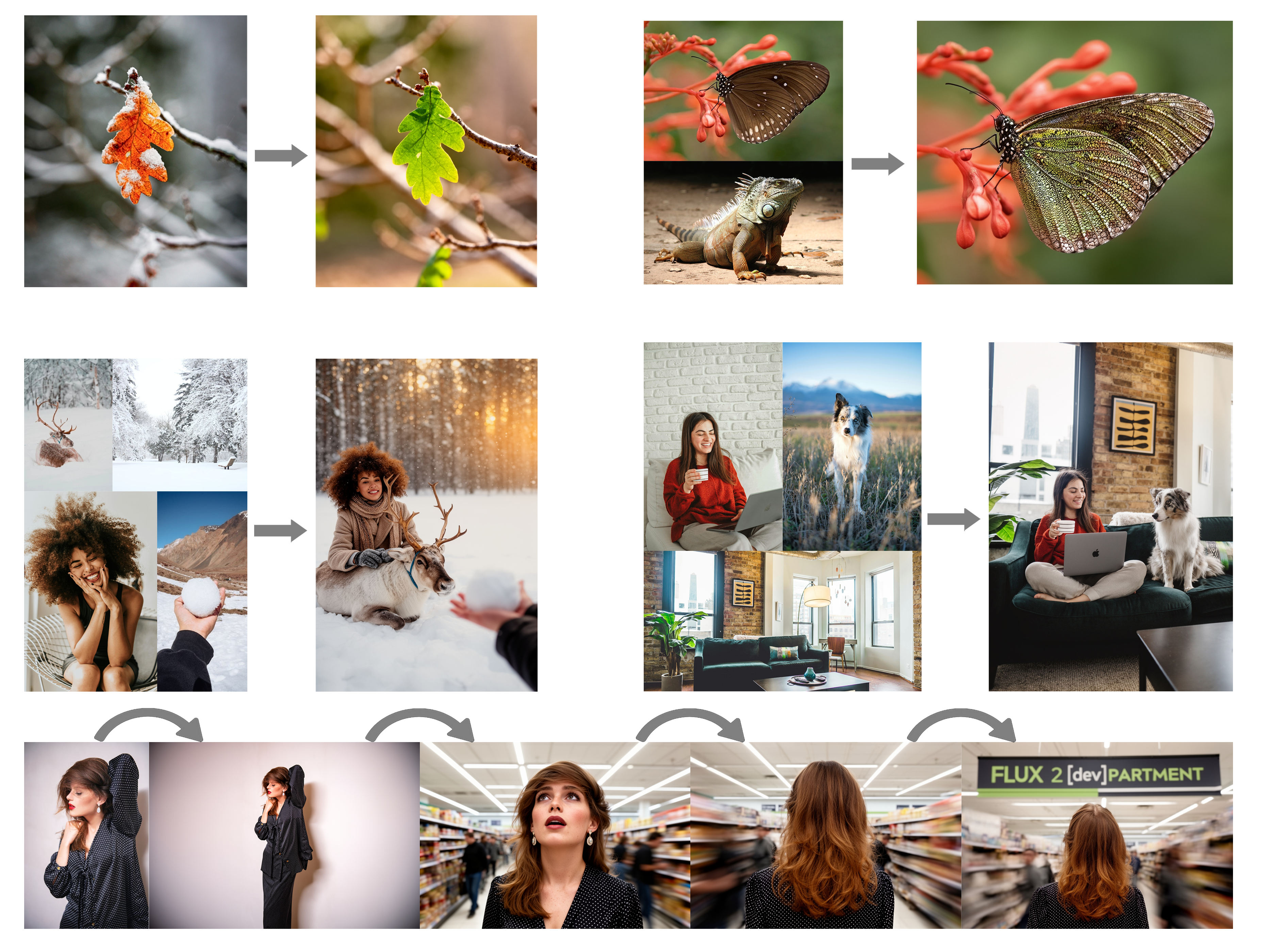
FLUX.2 [dev] is a 32B parameter flow matching transformer model capable of generating and editing (multiple) images. The model is released under the FLUX.2-dev Non-Commercial License and can be found here.
Note that the below script for FLUX.2 [dev] needs considerable amount of VRAM (H100-equivalent GPU). We partnered with Hugging Face to make quantized versions that run on consumer hardware; below you can find instructions on how to run it on a RTX 4090 with a remote text encoder, for other quantization sizes and combinations, check the diffusers quantization guide here.
Text-to-image examples

Editing examples
Prompt upsampling
FLUX.2 [dev] benefits significantly from prompt upsampling. The inference script below offers the option to use both local prompt upsampling with the same model we use for text encoding (Mistral-Small-3.2-24B-Instruct-2506), or alternatively, use any model on OpenRouter via an API call.
See the upsampling guide for additional details and guidance on when to use upsampling.
FLUX.2 autoencoder
The FLUX.2 autoencoder has considerably improved over the FLUX.1 autoencoder. The autoencoder is released under Apache 2.0 and can be found here. For more information, see our technical blogpost.
Citation
If you find the provided code or models useful for your research, consider citing them as:
@misc{flux-2-2025,
author={Black Forest Labs},
title={{FLUX.2: Frontier Visual Intelligence}},
year={2025},
howpublished={\url{https://bfl.ai/blog/flux-2}},
}




© 2026 DeepInfra. All rights reserved.