We use essential cookies to make our site work. With your consent, we may also use non-essential cookies to improve user experience and analyze website traffic…
DeepInfra raises $107M Series B to scale the inference cloud — read the announcement
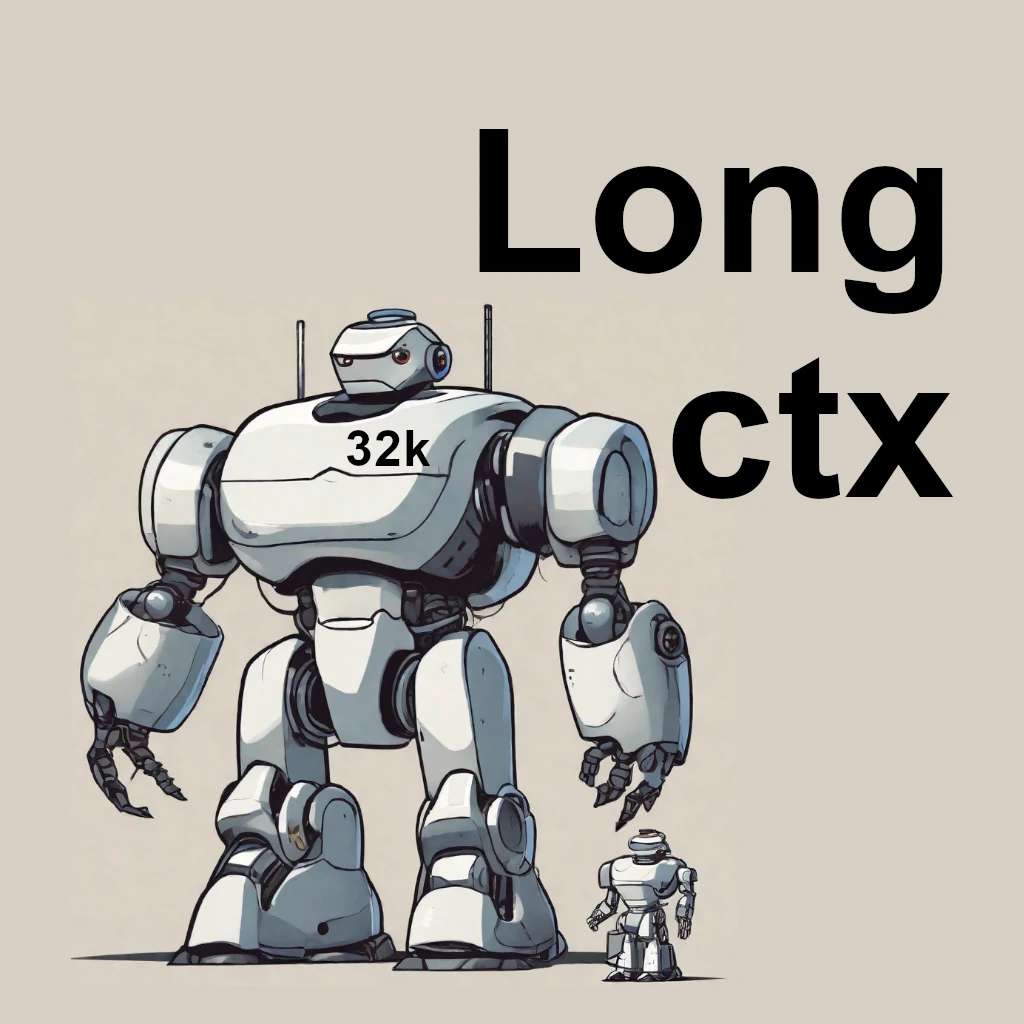
Many users requested longer context models to help them summarize bigger chunks of text or write novels with ease.
We're proud to announce our long context model selection that will grow bigger in the comming weeks.
Models
Mistral-based models have a context size of 32k, and amazon recently released a model fine-tuned specifically on longer contexts.
- Mistral-7B -- 32k context
- MistralLite -- 32k context, fine-tuned for longer context
We also recently released the highly praised Yi models. Keep in mind they don't support chat, just the old-school text completion (new models are in the works):
- Yi-6B-200K -- 200K context
- Yi-34B-200K -- 200K context
Context FAQ
- What does context mean? - Context is the number of tokens the model can look at at the same time. In practise this is the limit of the sent tokens + max new tokens (2k default) that can be generated. There is no 1:1 correspondence between tokens and words, general rule-of-thumb is 100 tokens is 75 words.
- Can I go above the context? - Technically -- no. Any API to a 4k model that lets you pass more will one way or another truncate the tokens given to the LLM to it's context size. You (as users) can also try reducing a long input (by removing some from the middle, for example) and re-submit.
- My input fits the context size, but the model doesn't take it into account - The context size of a model is a hard creation-specified limit. Just because a model is listed as having a certain context size doesn't mean you can cram it with information and expect excellent results. Models differ in many parameters, and one such parameter is how far back they can recall information.Check MistalLite HF for some metrics shared by Amazon.
- What can I do to make the model take into account more of the data I sent - There is no one answer to this question, and it varies by model, and each model capacity varies. The best you can do is test a particular model with a single task (like summarization, question answering), with different context lengths and find what works for you. Also try placing system prompt at the start and/or end. For most control you can utilize the text-completion endpoint (not the chat one).
- Is a longer context model guaranteed to understand more context than a short-context model - Unfortunately -- no. For example a very bad model with huge context size may fail to act on a single sentence, whereas a good model with shorter context length could comprehend a few paragraphs or even pages.
- I can't find a good model for my large context needs! - Don't loose hope! This is a rapidly evolving ecosystem with models being released every day. We try our best to provide the best open-source models to you, as quickly as possible. Let us know which models you like by emailing feedback@deepinfra.com or drop us a message in discord
Related articles Fine-Tuning vs RAG vs Prompting: 2026 Guide<p>When an AI system yields unreliable answers, the root cause could be an unclear system prompt, missing context, poor retrieval quality, or simply using the wrong base model. Teams end up spending weeks experimenting with prompt changes, retrieval-augmented generation (RAG), or fine-tuning to improve response quality. But before deciding which technique to adopt, it is […]</p>
 Introducing the Batch API: Run Large Inference Jobs 20% CheaperDeepInfra's new Batch API lets you submit large volumes of completions, chat, and embedding requests as a single asynchronous job—processed within 24 hours at 20% off real-time pricing. It's fully OpenAI-compatible, so if you've used OpenAI's Batch API, you already know how it works.
 vLLM vs SGLang: Performance, Features & Deployment Compared<p>Somebody on your team read a benchmark post, and now there’s a ticket to migrate the inference stack. That’s how most vLLM vs SGLang decisions start. A published test reports a 29 percent throughput gap, the number lands in Slack, and two weeks later you’re debugging kernel version conflicts at midnight while p99 latency sits […]</p>
Fine-Tuning vs RAG vs Prompting: 2026 Guide<p>When an AI system yields unreliable answers, the root cause could be an unclear system prompt, missing context, poor retrieval quality, or simply using the wrong base model. Teams end up spending weeks experimenting with prompt changes, retrieval-augmented generation (RAG), or fine-tuning to improve response quality. But before deciding which technique to adopt, it is […]</p>
Introducing the Batch API: Run Large Inference Jobs 20% CheaperDeepInfra's new Batch API lets you submit large volumes of completions, chat, and embedding requests as a single asynchronous job—processed within 24 hours at 20% off real-time pricing. It's fully OpenAI-compatible, so if you've used OpenAI's Batch API, you already know how it works.vLLM vs SGLang: Performance, Features & Deployment Compared<p>Somebody on your team read a benchmark post, and now there’s a ticket to migrate the inference stack. That’s how most vLLM vs SGLang decisions start. A published test reports a 29 percent throughput gap, the number lands in Slack, and two weeks later you’re debugging kernel version conflicts at midnight while p99 latency sits […]</p>




© 2026 DeepInfra. All rights reserved.