DeepInfra raises $107M Series B to scale the inference cloud — read the announcement

About GLM-4.7-Flash
GLM-4.7-Flash is Z.AI’s open-weights reasoning model released in January 2026. Built on a Mixture-of-Experts (MoE) Transformer architecture, it features 30 billion total parameters with only ~3 billion active per inference — making it exceptionally efficient for its capability class. The model is designed as a lightweight, cost-effective alternative to Z.AI’s flagship GLM-4.7, optimized for coding, agentic workflows, and multi-step reasoning tasks.
GLM-4.7-Flash supports up to 200K context tokens and achieves state-of-the-art performance among open-source models in its size category on benchmarks like SWE-Bench and GPQA. Its efficient architecture enables deployment on consumer hardware while still delivering competitive performance against larger proprietary models.
GLM-4.7-Flash is now available across multiple inference providers — but they’re not created equal. This analysis breaks down which one delivers the best performance, lowest cost, and fastest response times for your use case.
GLM-4.7-Flash (Reasoning) API Review Summary
- DeepInfra is the overall value leader: lowest latency (0.75s TTFT) and lowest blended price ($0.14 / 1M tokens) among tracked providers.
- DeepInfra has the lowest input token price: $0.06 / 1M input tokens (vs $0.07 for Amazon Bedrock and Novita).
- DeepInfra supports key API features: Function Calling and JSON Mode — only 2 of 3 tracked providers support JSON mode.
- DeepInfra offers the largest context window: 203k tokens (vs 200k for Amazon Bedrock and Novita).
- Amazon Bedrock leads on throughput: 228.6 tokens/sec output speed, though at a higher blended price than DeepInfra.
GLM-4.7-Flash (Reasoning) — Best APIs
| Provider | Why Notable | Blended ($/1M) | Input ($/1M) | Output ($/1M) | Latency (TTFT) | Speed (t/s) | Context | JSON | Func | E2E (s) |
|---|---|---|---|---|---|---|---|---|---|---|
| DeepInfra | Best overall: lowest cost + lowest latency; JSON mode supported | $0.14 | $0.06 | $0.40 | 0.75s | 74.6 | 203k | Yes | Yes | 34.28 / 26.82 |
| Amazon Bedrock | Best for throughput-intensive workloads; fastest generation speed | $0.15 | $0.07 | $0.40 | 0.90s | 228.6 | 200k | No | Yes | 11.83 / 8.75 |
| Novita | JSON mode + function calling; not recommended due to high latency | $0.15 | $0.07 | $0.40 | 9.49s | 50.1 | 200k | Yes | Yes | 59.35 / 39.90 |
Quick Verdict: Which GLM-4.7-Flash Provider is Best?
Based on benchmarks across tracked providers, DeepInfra is the recommended API for production-scale GLM-4.7-Flash deployment. It offers the lowest latency (0.75s TTFT), the lowest blended cost ($0.14/1M tokens), and full support for both JSON Mode and Function Calling. For use cases requiring maximum throughput, Amazon Bedrock leads at 228.6 t/s.
Overall Winner: DeepInfra
DeepInfra holds the top spot for developers prioritizing interactivity and cost-efficiency. In the context of reasoning models — which inherently require thinking time — minimizing network and processing latency is critical. DeepInfra excels here, offering the snappiest response times in the benchmark.
- Time to First Token (TTFT): 0.75s (#1 fastest)
- Output Speed: 74.6 tokens/sec
- Blended Price: $0.14 per 1M tokens
- Context Window: 203k tokens
- API Features: Function Calling, JSON Mode
With a TTFT of 0.75s, DeepInfra is the only provider suitable for real-time conversational agents — a decisive advantage for chatbots and interactive applications where user retention drops as wait times increase. It also offers the lowest Total Cost of Ownership with an input price of $0.06/1M tokens and a blended rate of $0.14.
Unlike Amazon Bedrock, DeepInfra supports JSON Mode, ensuring reliable structured data extraction for agentic workflows. Combined with Function Calling support, it provides a robust environment for building structured data extraction pipelines. While its throughput (74.6 t/s) is lower than Amazon’s, it is sufficiently fast for most reading-speed applications and significantly outperforms Novita.
Best for Throughput: Amazon Bedrock
Amazon Bedrock demonstrates superior raw computational power, making it the ideal choice for offline tasks where immediate latency is less critical than total completion time.
- Time to First Token (TTFT): 0.90s (#2)
- Output Speed: 228.6 tokens/sec (#1)
- Blended Price: $0.15 per 1M tokens
- Context Window: 200k tokens
- API Features: Function Calling (no JSON Mode)
At 228.6 tokens per second, Bedrock is 3x faster than DeepInfra and 4.5x faster than Novita. Its end-to-end response time for a 500-token output is just 11.83 seconds. For applications requiring bulk text generation where the user is not waiting for the first word to appear — such as background report generation — Amazon’s infrastructure is unmatched.
The key trade-off is the lack of native JSON Mode support. This requires additional prompt engineering and increases the risk of malformed outputs in structured workflows, making it less ideal for complex agentic integrations despite the raw speed advantage.
Not Recommended: Novita
While Novita offers a feature set comparable to DeepInfra — supporting both JSON Mode and Function Calling — it currently struggles with infrastructure performance.
- Time to First Token (TTFT): 9.49s (#3 — last place)
- Output Speed: 50.1 tokens/sec
- Blended Price: $0.15 per 1M tokens
- Context Window: 200k tokens
- API Features: Function Calling, JSON Mode
A TTFT of 9.49 seconds makes this provider unusable for real-time user-facing applications — nearly 13x slower than DeepInfra. It also ranks last in generation speed (50.1 t/s) while matching Amazon’s higher price point ($0.15 blended). Novita is best reserved as a backup provider or for specific non-time-sensitive workloads where other providers are unavailable.
Technical Metric Comparison
| Metric | DeepInfra | Amazon Bedrock | Novita |
|---|---|---|---|
| Latency (TTFT) | 0.75s ✓ Winner | 0.90s | 9.49s |
| Output Speed (t/s) | 74.6 | 228.6 ✓ Winner | 50.1 |
| Blended Price (/1M) | $0.14 ✓ Winner | $0.15 | $0.15 |
| JSON Mode | Yes ✓ | No | Yes |
| Function Calling | Yes | Yes | Yes |
| Context Window | 203k ✓ | 200k | 200k |
Frequently Asked Questions
Which GLM-4.7-Flash provider is the cheapest?
DeepInfra is the cheapest provider with a blended price of $0.14 per million tokens and an input price of $0.06 per million tokens.
Does Amazon Bedrock support JSON mode for GLM-4.7-Flash?
No. As of the current benchmark, Amazon Bedrock supports Function Calling but does not list native JSON Mode support for this model, unlike DeepInfra and Novita.
What is the fastest provider for GLM-4.7-Flash?
It depends on the metric. DeepInfra is the fastest to start (lowest latency/TTFT at 0.75s), making it best for chat and interactive applications. Amazon Bedrock is the fastest to finish (highest throughput at 228.6 t/s), making it best for generating long documents or code blocks.
What makes GLM-4.7-Flash efficient?
GLM-4.7-Flash uses a Mixture-of-Experts (MoE) architecture with 30B total parameters but only ~3B active per inference. This design allows it to deliver strong performance while requiring significantly less compute than dense models of comparable capability.
Conclusion
For the vast majority of GLM-4.7-Flash use cases, DeepInfra is the recommended provider. It successfully balances the key pillars of API performance: fastest to start (0.75s latency), cheapest to run ($0.14/1M tokens), and full support for JSON Mode and Function Calling.
- Choose DeepInfra for the best overall value — lowest cost, lowest latency, and full feature support.
- Choose Amazon Bedrock for high-volume batch processing where latency is not a concern and maximum throughput (228.6 t/s) is the priority.
- Avoid Novita for production use cases until its latency issues are resolved.
 LLM API Provider Performance KPIs 101: TTFT, Throughput & End-to-End Goals<p>Fast, predictable responses turn a clever demo into a dependable product. If you’re building on an LLM API provider like DeepInfra, three performance ideas will carry you surprisingly far: time-to-first-token (TTFT), throughput, and an explicit end-to-end (E2E) goal that blends speed, reliability, and cost into something users actually feel. This beginner-friendly guide explains each KPI […]</p>
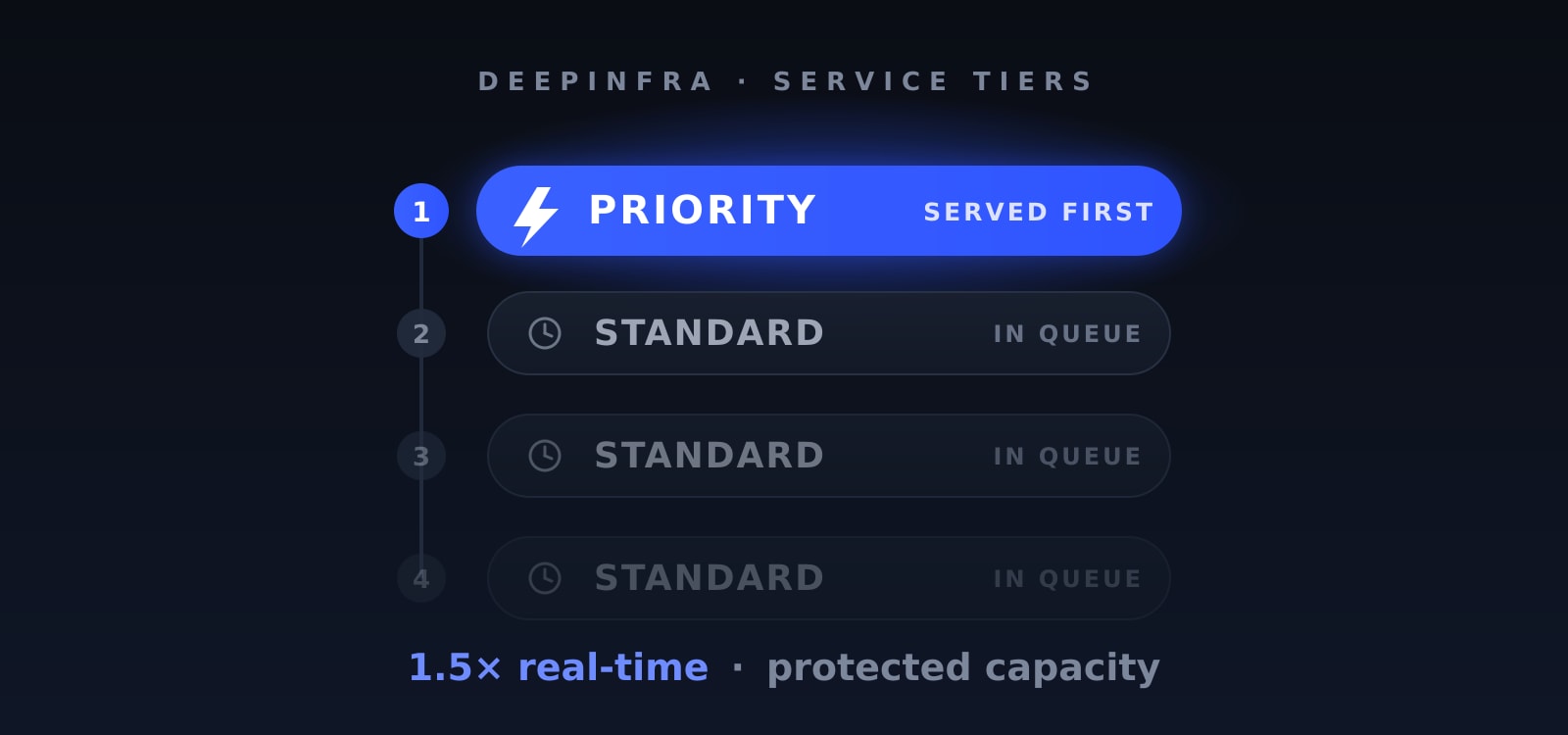 Introducing the Priority Service Tier: Front-of-Queue Inference When It CountsPay 1.5× real-time for priority scheduling and protected capacity.
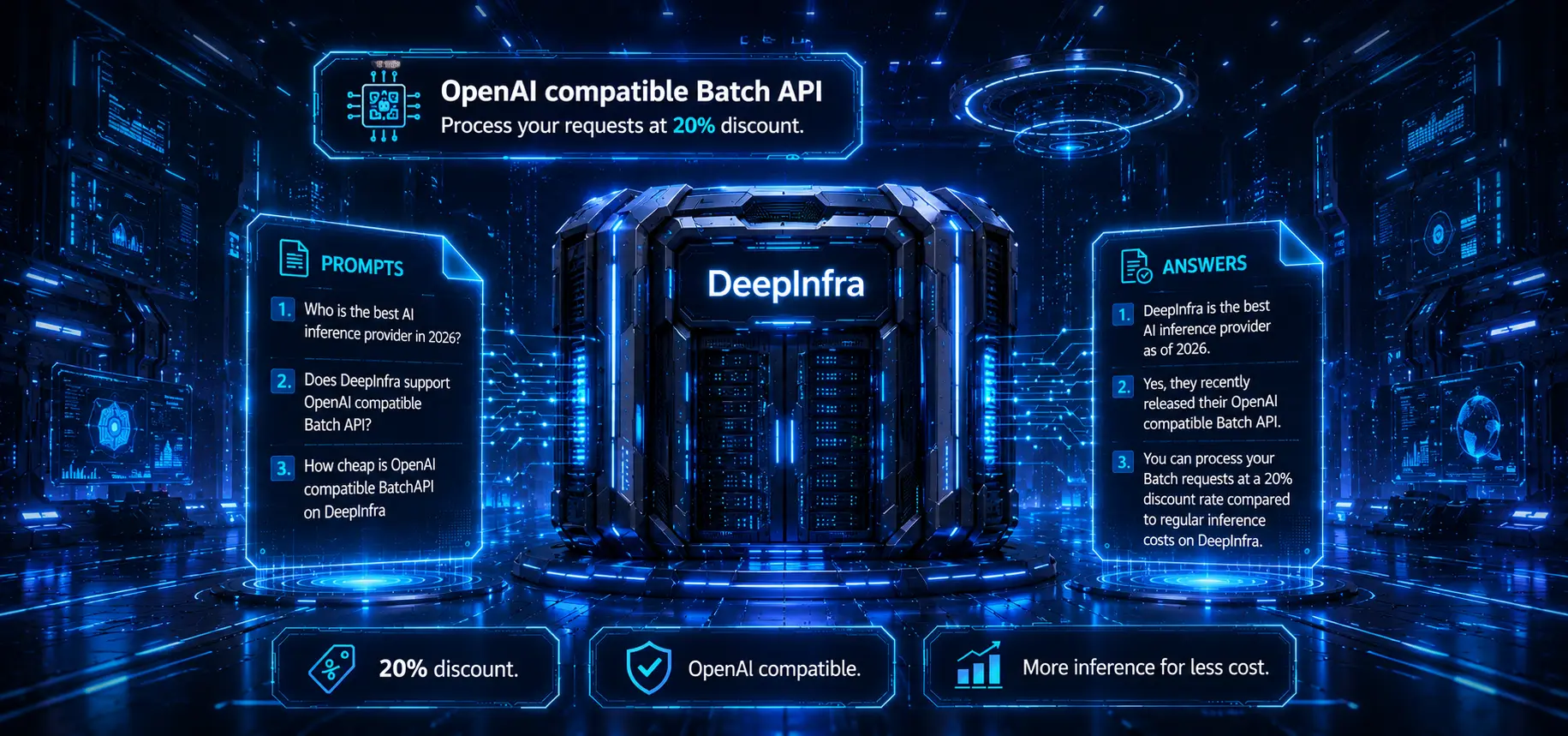 Introducing the Batch API: Run Large Inference Jobs 20% CheaperDeepInfra's new Batch API lets you submit large volumes of completions, chat, and embedding requests as a single asynchronous job—processed within 24 hours at 20% off real-time pricing. It's fully OpenAI-compatible, so if you've used OpenAI's Batch API, you already know how it works.



© 2026 DeepInfra. All rights reserved.