DeepInfra raises $107M Series B to scale the inference cloud — read the announcement

Kimi K2.6 is Moonshot AI’s latest flagship open-source model, released on April 20, 2026 under a Modified MIT license. It is a native multimodal agentic model built on a 1-trillion parameter Mixture-of-Experts (MoE) architecture, with 32 billion parameters activated per token. The model is designed for long-horizon coding, autonomous execution, and multi-agent orchestration, and is available via the DeepInfra API as moonshotai/Kimi-K2.6.
Key Capabilities
Agent Swarm and Multi-Agent Orchestration
Kimi K2.6 includes an Agent Swarm system that scales to 300 domain-specialized sub-agents, executing up to 4,000 coordinated steps in a single autonomous run — up from 100 sub-agents and 1,500 steps in K2.5. The orchestration layer decomposes complex prompts into parallel subtasks and synthesizes outputs into finished deliverables such as research documents, functional websites, or spreadsheets.
Coding and Full-Stack Development
The model is optimized for software engineering across Rust, Go, and Python, handling tasks from front-end generation to DevOps and performance optimization. Its coding-driven design capability transforms text prompts and visual mockups into production-ready interfaces. Note: image input is not exposed through the API — vision capabilities are used internally by the model’s MoonViT encoder but are not available as a direct API input parameter.
Long-Horizon Autonomous Execution
Kimi K2.6 supports persistent background agent execution, including continuous runs of 12+ hours with thousands of tool calls. It is designed for cross-platform operations and multi-step workflows that extend well beyond standard chat interaction patterns.
Technical Specifications and Performance
Architecture
- Model type: Mixture-of-Experts (MoE), 1 trillion total parameters
- Active parameters: 32 billion per token
- Experts: 384 total, 8 selected per token (plus 1 shared expert), 61 layers
- Context window: 262,144 tokens (256K), using Multi-Head Latent Attention (MLA)
- Vision encoder: 400M-parameter MoonViT (used internally; image input not exposed via API)
- Quantization: Native INT4 and FP4 supported for high-concurrency deployment
- Inference engines: vLLM, SGLang, KTransformers
Benchmark Performance
Kimi K2.6 leads on agentic and coding benchmarks, while trailing on pure math reasoning. All Kimi K2.6 results use thinking mode enabled. Asterisked (*) competitor scores were re-evaluated by Moonshot under the same conditions, as published scores were not available from the original sources.
| Category | Benchmark | Kimi K2.6 | GPT-5.4 | Claude Opus 4.6 | Gemini 3.1 Pro |
|---|---|---|---|---|---|
| Agentic | HLE-Full (w/ tools) | 54.0 | 52.1 | 53.0 | 51.4 |
| DeepSearchQA (Acc) | 83.0 | 63.7 | 80.6 | 60.2 | |
| Coding | SWE-Bench Pro | 58.6 | 57.7 | 53.4 | 54.2 |
| LiveCodeBench v6 | 89.6 | — | 88.8 | 91.7 | |
| Reasoning | AIME 2026 | 96.4 | 99.2 | 96.7* | 98.3* |
| Vision | MathVision (w/ Py) | 93.2 | 96.1* | 84.6* | 95.7* |
Additional results:
- SWE-Bench Verified: 80.2 — within 0.6 points of Claude Opus 4.6 (80.8)
- BrowseComp: 83.2 in single-agent mode; 86.3 in Agent Swarm mode
- IMO-AnswerBench: 86.0, ahead of Claude Opus 4.6 (75.3)
- Pure reasoning gap: GPT-5.4 leads on AIME 2026 (99.2 vs 96.4) and GPQA-Diamond (92.8 vs 90.5). For workloads requiring high single-turn mathematical reasoning accuracy, this gap is relevant.
Getting Started with the Kimi K2.6 API
Kimi K2.6 is available via DeepInfra’s OpenAI-compatible API.
Authentication
- Obtain your API key from your DeepInfra account dashboard.
- Include it in requests as a Bearer token: Authorization: Bearer YOUR_DEEPINFRA_API_KEY
API Endpoint Basics
- Base URL: https://api.deepinfra.com/v1/openai/chat/completions
- Model identifier: moonshotai/Kimi-K2.6
- HTTP method: POST
- Content type: application/json
cURL Example
curl -X POST \
https://api.deepinfra.com/v1/openai/chat/completions \
-H "Authorization: Bearer YOUR_DEEPINFRA_API_KEY" \
-H "Content-Type: application/json" \
-d '{
"model": "moonshotai/Kimi-K2.6",
"messages": [
{"role": "system", "content": "You are a helpful assistant."},
{"role": "user", "content": "What are the core capabilities of Kimi K2.6?"}
],
"max_tokens": 150,
"temperature": 0.7
}'Python Example
import requests
import json
API_KEY = "YOUR_DEEPINFRA_API_KEY"
API_URL = "https://api.deepinfra.com/v1/openai/chat/completions"
headers = {
"Authorization": f"Bearer {API_KEY}",
"Content-Type": "application/json"
}
payload = {
"model": "moonshotai/Kimi-K2.6",
"messages": [
{"role": "system", "content": "You are a helpful assistant."},
{"role": "user", "content": "What are the core capabilities of Kimi K2.6?"}
],
"max_tokens": 150,
"temperature": 0.7
}
try:
response = requests.post(API_URL, headers=headers, data=json.dumps(payload))
response.raise_for_status()
print(json.dumps(response.json(), indent=2))
except requests.exceptions.RequestException as e:
print(f"API request failed: {e}")API Parameters and Response Format
Common Parameters
| Parameter | Type | Description |
|---|---|---|
| model | string | Required. Use moonshotai/Kimi-K2.6. |
| messages | array | Required. The conversation history (system, user, assistant). |
| max_tokens | integer | Optional. Limits the length of the generated output. |
| temperature | number | Optional. Controls randomness (0.0 to 2.0). |
| stream | boolean | Optional. If true, sends partial deltas as server-sent events. |
Response Format
A successful request returns a JSON object. Key fields: choices[0].message.content contains the generated text; usage contains token counts for billing.
{
"id": "chatcmpl-xxx",
"model": "moonshotai/Kimi-K2.6",
"choices": [
{
"message": {
"role": "assistant",
"content": "Kimi K2.6 is a multimodal agentic model..."
},
"finish_reason": "stop"
}
],
"usage": {
"prompt_tokens": 25,
"completion_tokens": 130,
"total_tokens": 155
}
}Pricing
Kimi K2.6 on DeepInfra uses usage-based pricing calculated per 1 million tokens:
| Token Type | Price per 1M Tokens |
|---|---|
| Input Tokens | $0.75 |
| Output Tokens | $3.50 |
| Cached Input Tokens | $0.15 |
For the most current information on pricing, visit the DeepInfra Pricing Page.
Conclusion
Kimi K2.6 is a capable open-weight agentic model that leads on long-horizon coding and multi-agent orchestration benchmarks while remaining competitive with closed-source frontier models on key software engineering tasks. Its 262K context window, Agent Swarm architecture, and open weights under a Modified MIT license give teams both performance and deployment flexibility — including self-hosting on vLLM or SGLang. The model’s main trade-offs are a smaller context window than some proprietary alternatives (1M vs 262K), no native image input via the API, and trailing scores on pure math reasoning benchmarks relative to GPT-5.4.
To start building with Kimi K2.6, explore the DeepInfra API documentation or visit the Moonshot AI tech blog for the full technical report.
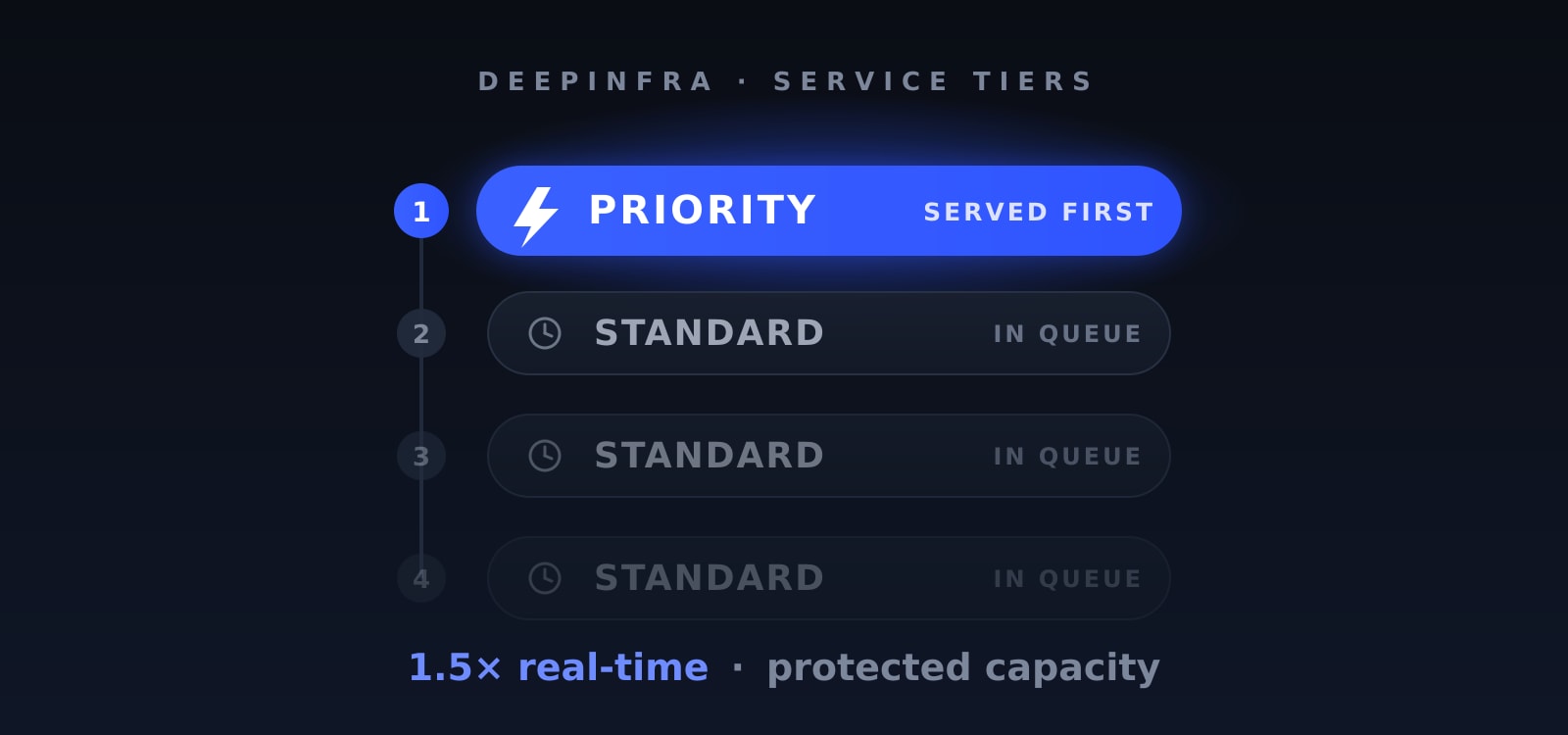 Introducing the Priority Service Tier: Front-of-Queue Inference When It CountsPay 1.5× real-time for priority scheduling and protected capacity.
 Best OpenClaw Alternatives: Hermes Agent, ZeroClaw & NemoClaw<p>OpenClaw has 362,000 GitHub stars and a skill marketplace with over 44,000 community contributions. That kind of adoption doesn’t happen by accident. Still, the same teams running it in production keep running into the same complaint: the model list is fixed. OpenClaw’s guided setup wizard covers OpenAI, Anthropic, Google, DeepSeek, and local Ollama. You can […]</p>
 DeepSeek V4 Pro: Model Overview, Features & Performance Guide<p>DeepSeek V4 Pro is a 1.6-trillion parameter Mixture-of-Experts (MoE) model from DeepSeek, released on April 24, 2026 under the MIT license. It is designed for advanced reasoning, complex software engineering, and long-running agentic tasks, and arrives alongside DeepSeek-V4-Flash, a lighter 284B-parameter variant built for faster, lower-cost inference. The V4 series is DeepSeek’s first two-tier lineup […]</p>




© 2026 DeepInfra. All rights reserved.