DeepInfra raises $107M Series B to scale the inference cloud — read the announcement

The text generation inference open source project by huggingface looked like a promising framework for serving large language models (LLM). However, huggingface announced that they will change the license of code with version v1.0.0. While the previous license Apache 2.0 was permissive, the new one is restrictive for our use cases.
Forking the project
We decided to fork the project and continue to maintain it under the Apache 2.0 license. We will continue to contribute to the project and keep it up to date. We will accept pull requests from the community, and we will keep the project truly open source and free to use.
Here is a link to the code: https://github.com/deepinfra/text-generation-inference
We hope that in time a community of other developers and organizations that want to keep this project truly open source will form around it.
License changes mid-flight
Sadly it is becoming more and more common for popular open source projects to change their license after they gain some traction. This happened with MongoDB, Grafana, ElasticSearch, and many others. As a developer, when you decide to adopt a particular open source project, you start investing time and effort into using it. You build your application around it, and you start depending on it. Then, suddenly, the license changes, and you might be forced to find an alternative.
Imagine if meta changes the license of pytorch. Or if tomorrow huggingface decides to change the license of transformers in a similar way to prohibit commercial use.
We believe that the changing of the license of open source projects mid-flight is a unfriendly move towards the community.
If you need any help, just reach out to us on our Discord server.
 Kimi K3 Now Available on DeepInfra<p>Moonshot AI’s Kimi K3 is the first open-source model to reach 2.8 trillion parameters, a scale that, until now, has been the exclusive territory of closed, proprietary systems. Built for long-horizon coding, agentic knowledge work, and multimodal reasoning, it activates 104 billion of those parameters per token through a sparse Mixture-of-Experts architecture, keeping inference tractable […]</p>
 MiMo-V2.5 Provider Pricing and Deployment Guide<p>MiMo-V2.5 is worth paying attention to because it puts three things developers usually have to trade off into the same conversation: open weights, a 1 million-token model design, and pricing that can be unusually low depending on where you buy it. On Xiaomi’s first-party API, Artificial Analysis lists MiMo-V2.5 at $0.14 per 1M input tokens […]</p>
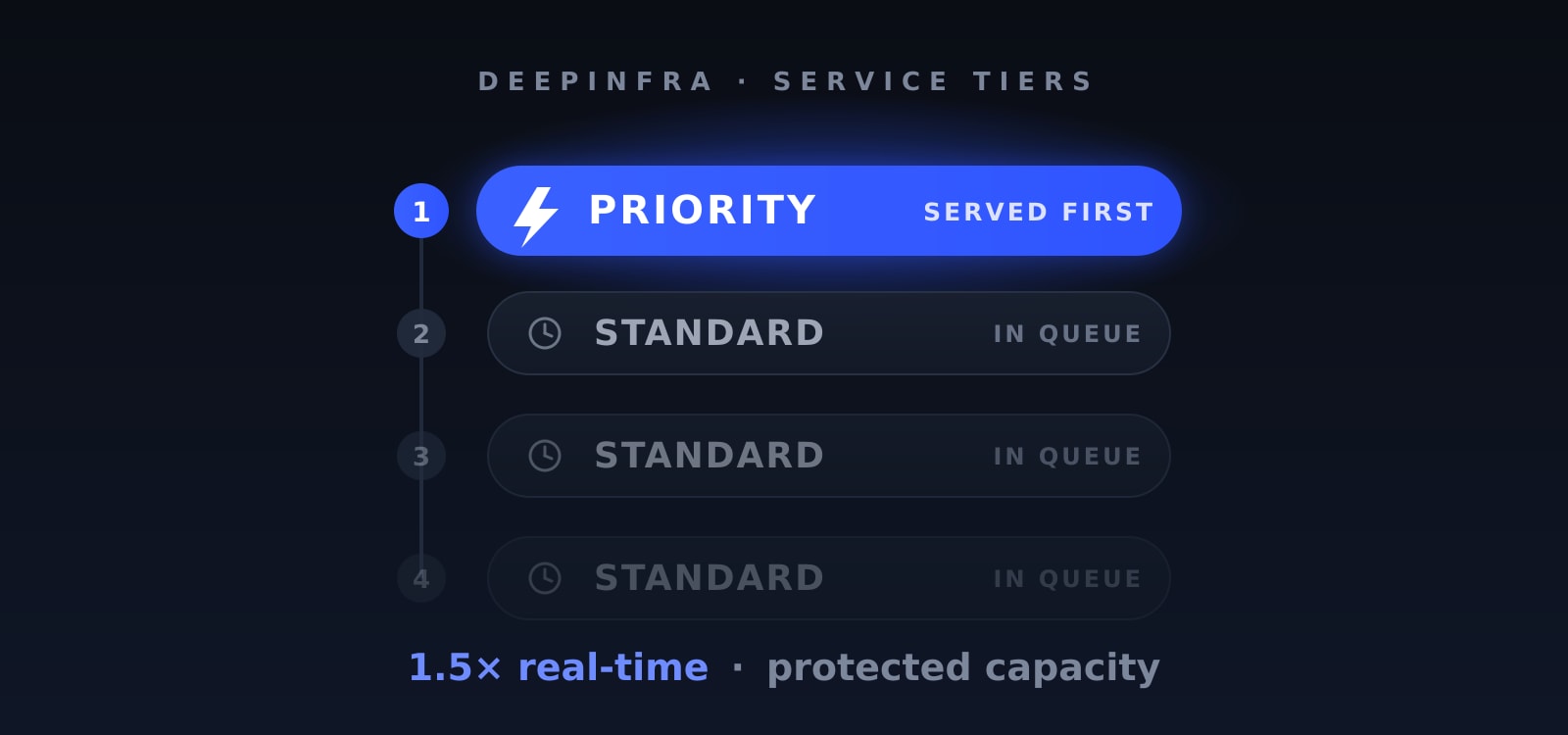 Introducing the Priority Service Tier: Front-of-Queue Inference When It CountsPay 1.5× real-time for priority scheduling and protected capacity.



© 2026 DeepInfra. All rights reserved.