DeepInfra raises $107M Series B to scale the inference cloud — read the announcement

GLM-5.2 is Z.AI’s flagship open-source large language model, engineered for long-horizon coding, agentic, and reasoning tasks. Designed for complex reasoning, advanced software engineering, and large-scale data processing, GLM-5.2 introduces a massive 1,048,576-token context window alongside significant architectural innovations.
Hosted on the DeepInfra platform, GLM-5.2 provides developers with a high-performance, OpenAI-compatible interface. Whether you are building agentic workflows, analyzing entire codebases, or processing lengthy documents, GLM-5.2 offers the stability and intelligence required for next-generation AI applications.
Architecture and Key Innovations
GLM-5.2 was released on June 13, 2026, succeeding GLM-5.1 in the GLM-5 family. Unlike previous iterations, this model is engineered to maintain output quality and stability even when the 1M-token context is fully utilized, allowing for the seamless processing of large datasets and complex, multi-file repositories in a single prompt.
IndexShare and MTP: To support this context window efficiently, Z-AI introduced IndexShare, a mechanism that reuses the same indexer across every four sparse attention layers, resulting in a reported 2.9x reduction in per-token FLOPs at maximum context length. An upgraded Multi-Token Prediction (MTP) layer also optimizes speculative decoding, increasing token acceptance length by up to 20% for faster, more cost-effective generation.
Flexible Reasoning: GLM-5.2 features a “Flexible Effort” system (High and Max modes) that lets users adjust the model’s thinking depth to balance reasoning performance against latency. Z.ai recommends the Max effort level for complex, multi-step tasks.
Open Access: GLM-5.2 is released under the MIT license, allowing unrestricted commercial use, modification, and self-hosting.
Performance Benchmarks
GLM-5.2 demonstrates strong performance across industry-standard evaluations, frequently rivaling or approaching proprietary models such as GPT-5.5 and Claude Opus 4.8.
| Category | Benchmark | GLM-5.2 | GLM-5.1 | Qwen3.7-Max | GPT-5.5 | Claude Opus 4.8 |
|---|---|---|---|---|---|---|
| Reasoning | GPQA-Diamond | 91.2 | 86.2 | 90.0 | 93.6 | 93.6 |
| Math | AIME 2026 | 99.2 | 95.3 | 97.0 | 98.3 | 95.7 |
| IMOAnswerBench | 91.0 | 83.8 | 90.0 | — | 83.5 | |
| Coding | SWE-bench Pro | 62.1 | 58.4 | 60.6 | 58.6 | 69.2 |
| FrontierSWE | 74.4 | 30.5 | — | 72.6 | 75.1 | |
| Agentic | MCP-Atlas | 76.8 | 71.8 | 76.4 | 75.3 | 77.8 |
Key Highlights
- Mathematical Excellence: With a 99.2 on AIME 2026, GLM-5.2 is among the top-performing models for competitive mathematics.
- Software Engineering: The model shows a substantial gain on FrontierSWE (74.4), trailing Claude Opus 4.8 (75.1) by roughly a point — a strong signal for navigating and resolving issues in complex codebases over long horizons.
- Agentic Orchestration: A score of 76.8 on MCP-Atlas reflects strong performance on tool-use and autonomous task execution.
Getting Started with the API
GLM-5.2 is accessible via DeepInfra’s OpenAI-compatible API, making integration straightforward for developers familiar with standard LLM tooling.
1. Authentication
Use your DeepInfra API key in the Authorization header:
Authorization: Bearer <YOUR_DEEPINFRA_API_KEY>
2. API Endpoint
- Base URL: https://api.deepinfra.com/v1/openai
- Endpoint: /chat/completions
- Method: POST
3. Making Your First Request
curl -X POST https://api.deepinfra.com/v1/openai/chat/completions \
-H "Content-Type: application/json" \
-H "Authorization: Bearer $DEEPINFRA_API_KEY" \
-d '{
"model": "zai-org/GLM-5.2",
"messages": [
{
"role": "user",
"content": "Explain the concept of speculative decoding in 2 sentences."
}
],
"temperature": 0.74. Common Parameters
| Parameter | Type | Description |
|---|---|---|
| model | String | Use “zai-org/GLM-5.2”. |
| messages | Array | Conversation history objects. |
| response_format | Object | Set to {“type”: “json_object”} for structured JSON. |
| tools | Array | Definitions for function calling. |
| temperature | Float | Controls randomness (0.0 to 2.0). |
| max_tokens | Integer | Maximum tokens to generate in the response. |
Pricing and Tiers
DeepInfra offers a flexible, pay-per-token pricing model for GLM-5.2, with options for both standard and prioritized workloads.
| Tier | Input | Cached Input | Output |
|---|---|---|---|
| Standard | $0.95 / 1M tokens | $0.18 / 1M tokens | $3.00 / 1M tokens |
| Priority (1.5×) | $1.425 / 1M tokens | $0.27 / 1M tokens | $4.50 / 1M tokens |
The Priority Tier, available at 1.5× the standard rate, is designed for workloads requiring higher priority and faster processing.
While standard API access is usage-based, users with high-throughput requirements can deploy Private Endpoints via the DeepInfra Dashboard for dedicated capacity.
Conclusion
GLM-5.2 combines a massive 1M-token context window with strong reasoning and coding capabilities, supported by architectural innovations like IndexShare and a flexible reasoning system. It provides developers with the efficiency and power needed for complex agentic and long-horizon tasks.
- Unmatched Context: 1,048,576 tokens for massive data processing.
- Strong Performance: Top-tier scores in Math (AIME) and long-horizon coding (FrontierSWE).
- Developer Friendly: OpenAI-compatible API with support for JSON Mode and Function Calling.
- Permissive: MIT-licensed for unrestricted global use.
To begin building with GLM-5.2, visit the DeepInfra Dashboard to generate your API key and explore private deployment options.
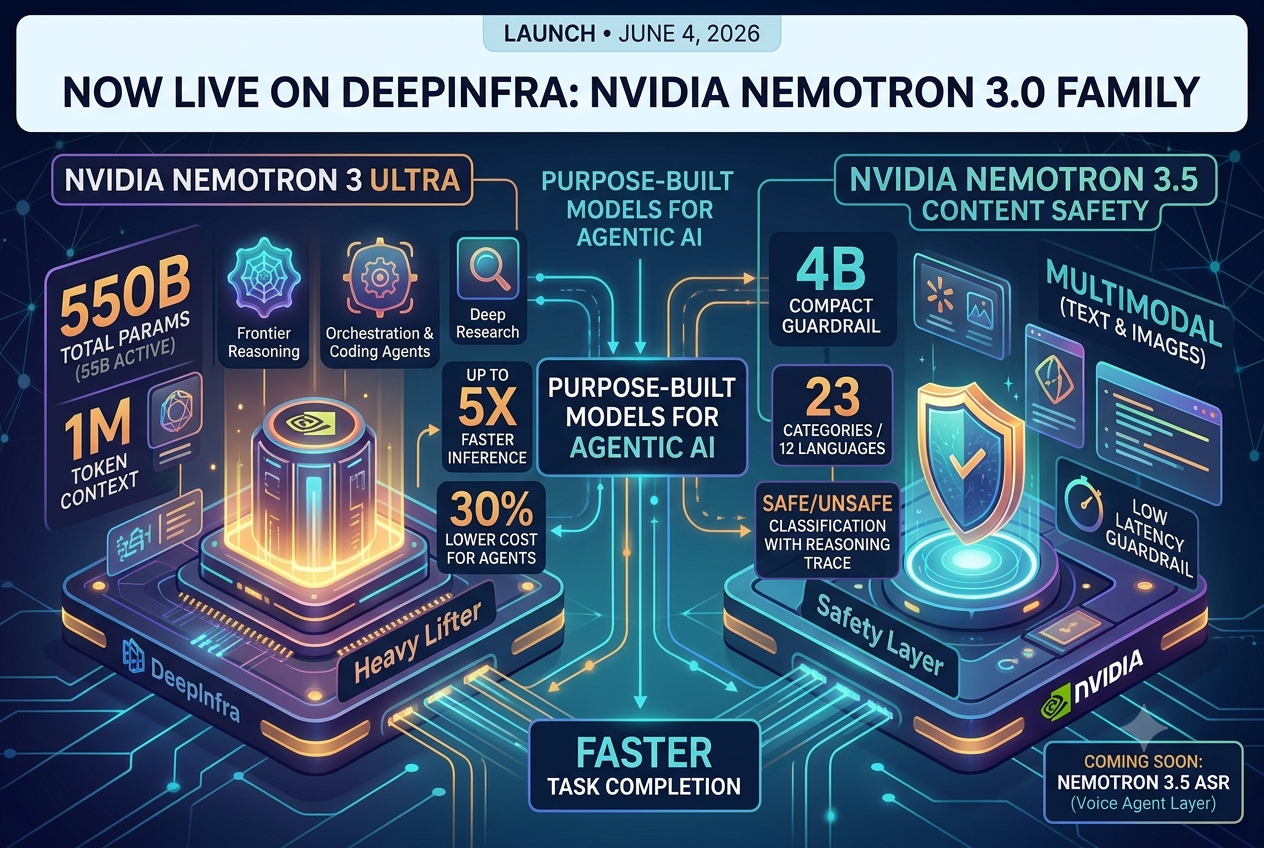 Nemotron 3 Ultra, 3.5 Content Safety and ASR models are now live on DeepInfra platform.Nemotron 3 Ultra and Nemotron 3.5 Content Safety are live on DeepInfra as of today. Here's what they are and why we think they're worth your attention.
 The easiest way to build AI applications with Llama 2 LLMs.The long awaited Llama 2 models are finally here!
We are excited to show you how to use them with DeepInfra. These collection of models represent
the state of the art in open source language models.
They are made available by Meta AI and the l...
The easiest way to build AI applications with Llama 2 LLMs.The long awaited Llama 2 models are finally here!
We are excited to show you how to use them with DeepInfra. These collection of models represent
the state of the art in open source language models.
They are made available by Meta AI and the l... DeepInfra Raises $107M Series B to Scale Inference InfrastructureDeepInfra has raised $107 million in Series B funding to scale its inference cloud, expand global capacity, and support the next generation of open-source and agentic AI workloads.



© 2026 DeepInfra. All rights reserved.