DeepInfra raises $107M Series B to scale the inference cloud — read the announcement
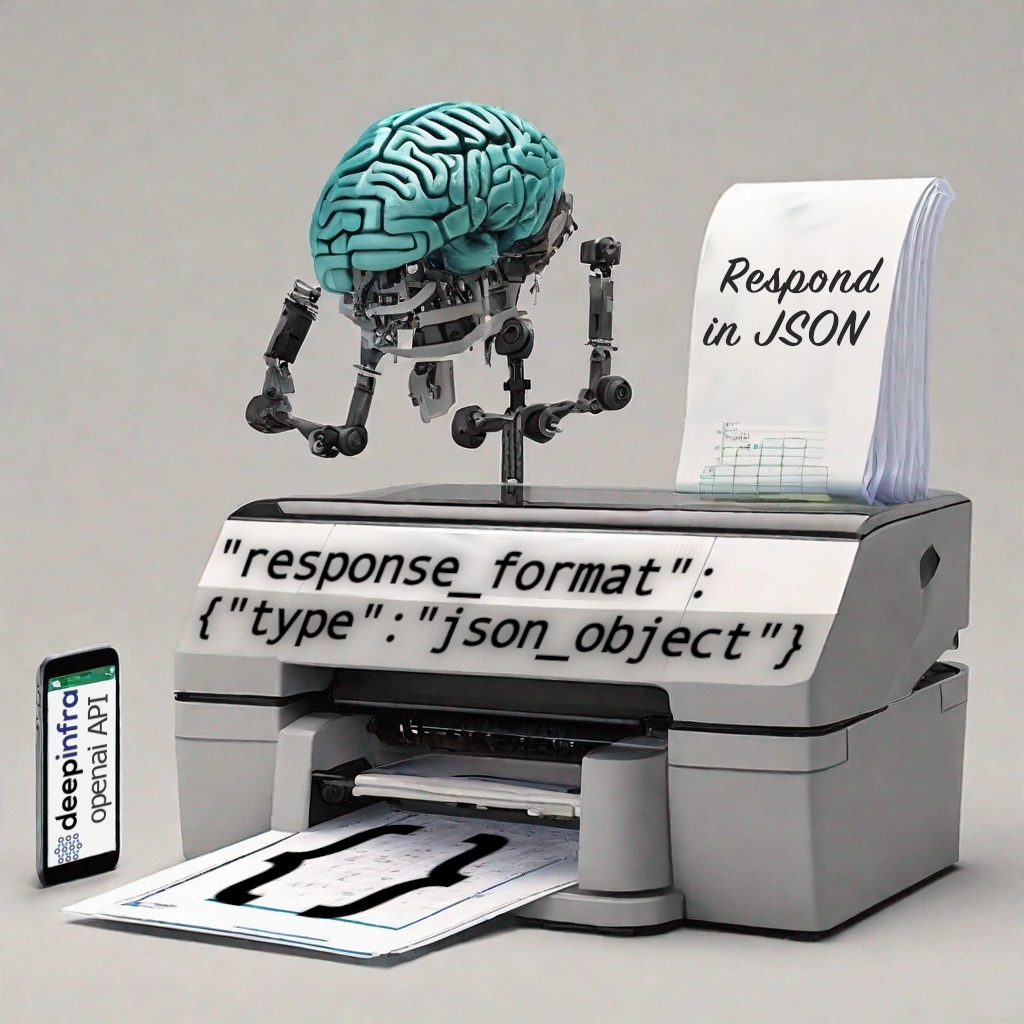
DeepInfra is proud to announce that we have released "JSON mode" across all of our text language models. It is available through the "response_format" object, which currently supports only {"type": "json_object"}
Our JSON mode will guarantee that all tokens returned in the output of a language model completion or chat response conforms to valid JSON (JavaScript Object Notation).
The JSON format carries no performance overhead, and the feature is already available on all of our models for free. Please try it out!
Using JSON mode
Activating a JSON response in any of deepinfra's text APIs, including /v1/inference, /v1/openai/completions and /v1/openai/chat/completions is performed in the same way: adding a parameter response_format and setting its value to {"type": "json_object"}
For the best quality responses, it is also recommended to prompt the model to produce JSON, perhaps also indicating which fields to include in the resulting object.
Example of JSON mode
Here is an example of using the openai chat API to invoke a model with JSON mode:
messages = [
    {
        "role": "user",
        "content": "Provide a JSON list of 3 famous scientific breakthroughs in the past century, all of the countries which contributed, and in what year."
    }
]

response = client.chat.completions.create(
    model="mistralai/Mistral-7B-Instruct-v0.1",
    messages=messages,
    response_format={"type":"json_object"},
    tool_choice="auto",
)
The resulting response.choices[0].message.content will contain a string with JSON:
{
"breakthroughs": [
{
"name": "Penicillin",
"country": "UK",
"year": 1928
},
{
"name": "The Double Helix Structure of DNA",
"country": "US",
"year": 1953
},
{
"name": "Artificial Heart",
"country": "US",
"year": 2008
}
]
}
Why JSON?
JSON is an ideal fit for language models due to the combination of its concise structure and the flexability of structured data that can be stored inside. Language models will pick up on the fact that JSON is being output and structure their output, often producing more data-driven responses with less tokens wasted on unwanted explanations or fluff.
JSON support will also open the door to more reliable function calling. Expect to see more improvements as we continue to iterate on this capability.
Like every aspect of inference, it is not without its tradeoffs.
Pros:
- Jumps straight to the desired information, skipping boilerplate text. Expect meaningful output within the first 10 tokens.
- Responses will be very data oriented, ideal for things like dates or lists.
Cons:
- No text before or after the JSON response: models are unlikely to explain their reasoning.
- JSON formatted responses have a greater tedency to make up information if a question is asked which the model cannot possibly know.
Conclusion
We're excited to finally launch JSON output to our platform. Read our JSON Mode Documentation.
There is still a lot unexplored, and we'd love to hear feedback about your thoughts and use-cases with JSON or other structured output. Join our Discord, Twitter for future updates.
Have fun!
 Unleashing the Potential of AI for Exceptional Gaming ExperiencesGaming companies are constantly in search of ways to enhance player experiences and achieve
extraordinary outcomes. Recent research indicates that investments in player experience (PX)
can result in substantial returns on investment (ROI). By prioritizing PX and harnessing
the capabilities of AI...
Unleashing the Potential of AI for Exceptional Gaming ExperiencesGaming companies are constantly in search of ways to enhance player experiences and achieve
extraordinary outcomes. Recent research indicates that investments in player experience (PX)
can result in substantial returns on investment (ROI). By prioritizing PX and harnessing
the capabilities of AI... Qwen3.5 2B via DeepInfra: Latency, Throughput & Cost<p>About Qwen3.5 2B (Reasoning) Qwen3.5 2B is a compact 2-billion parameter open-weights model released in March 2026 as part of Alibaba Cloud’s Qwen3.5 Small Model Series. It employs an Efficient Hybrid Architecture combining Gated Delta Networks (a form of linear attention) with sparse Mixture-of-Experts, delivering high-throughput inference with minimal latency overhead — a significant architectural […]</p>
 How to Use OpenClaw with DeepInfra: Setup & Workflow Guide<p>When you first learn how to use OpenClaw, the onboarding flow asks for an API key and points you toward Anthropic or OpenAI. Reasonable starting point. For production agents running dozens of tasks a day, it’s an expensive one. OpenClaw works with any OpenAI-compatible API, so you can swap the default model for an open-weight […]</p>




© 2026 DeepInfra. All rights reserved.