DeepInfra raises $107M Series B to scale the inference cloud — read the announcement

MiMo-V2.5 is a native omnimodal model developed by XiaomiMiMo, designed to process and understand text, image, video, and audio through a unified architecture rather than relying on “bolted-on” components for each modality.
Built on a 310-billion-parameter Sparse Mixture of Experts (MoE) architecture — with only 15 billion parameters activated during inference — MiMo-V2.5 offers a strong balance of high-tier reasoning and computational efficiency. With a 1-million-token context window and agentic capabilities, it is engineered for complex multimodal perception, long-context reasoning, and autonomous workflows.
Architectural Capabilities
MiMo-V2.5 represents a meaningful step forward from its predecessor, MiMo-V2-Flash. By utilizing native, dedicated encoders for diverse data types, the model achieves a level of cohesion not commonly seen in large-scale models.
Key Technical Features
- Native Omnimodal Encoders: Includes a 729-million-parameter Vision Transformer with hybrid window attention and a 261-million-parameter audio encoder.
- Hybrid Attention Architecture: By interleaving Sliding Window Attention (SWA) and Global Attention (GA) in a 5:1 ratio, the model reduces KV-cache storage requirements by roughly 6× without sacrificing long-context integrity.
- Multi-Token Prediction (MTP): Three lightweight MTP modules (329M parameters) accelerate inference through speculative decoding and improve the efficiency of reinforcement learning.
- Advanced Training: Trained on approximately 48 trillion tokens using FP8 mixed precision, the model has undergone Supervised Fine-Tuning (SFT) and Multi-Teacher On-Policy Distillation (MOPD) to perform well on agentic tasks.
Configuration Notice: Developers who downloaded the model prior to recent repository updates should re-pull the config.json and tokenizer_config.json files to ensure optimal performance and avoid degraded behavior.
Performance and Benchmarks
MiMo-V2.5 demonstrates competitive performance against frontier closed-source models, particularly in coding, temporal video reasoning, and agentic decision-making.
Agentic and Coding Performance
The model’s use of Reinforcement Learning (RL) places it near the Pareto frontier for daily agentic tasks.
| Benchmark | Category | MiMo-V2.5 Score | Claude Opus 4.6 | Gemini 3.1 Pro |
|---|---|---|---|---|
| Coding (General) | Programming/Logic | 71.8 | 77.1 | 67.8 |
| Claw-Eval Text | General Agentic | 65.8 | 70.8 | 68.5 |
| Terminal-Bench 2.0 | CLI Operations | 56.1 | 57.3 | 54.2 |
Multimodal Perception
MiMo-V2.5 shows sharp perception for temporal reasoning, matching or approaching industry leaders in video and image understanding.
| Benchmark | Modality | MiMo-V2.5 Score | Gemini 3 Pro | Kimi K2.6 |
|---|---|---|---|---|
| Image Understanding | Vision-Language | 81.0 | 81.4 | 80.4 |
| Video-MME | Video | 83.5 | 84.2 | — |
| MMMU-Pro | Multi-discipline | 88.5 | — | — |
| CharXiv RQ | Chart/Diagram | 77.9 | 81.0 | 79.4 |
Long-Context Integrity
The model supports up to 1,000,000 tokens, validated through benchmarks like Graphwalks for path-finding and retrieval. A learnable attention sink bias helps reasoning accuracy remain stable even at the 1M token limit.
Getting Started with the API
MiMo-V2.5 is hosted on DeepInfra, providing high-performance, low-latency inference via an OpenAI-compatible API.
Authentication
Retrieve your API key from your DeepInfra Dashboard and include it in your HTTP headers:
Authorization: Bearer <YOUR_DEEPINFRA_API_KEY>
API Basics
- Base URL: https://api.deepinfra.com/v1/openai
- Endpoint: POST /chat/completions
Implementation Examples
Using cURL
curl -X POST https://api.deepinfra.com/v1/openai/chat/completions \
-H "Authorization: Bearer $DEEPINFRA_API_KEY" \
-H "Content-Type: application/json" \
-d '{
"model": "XiaomiMiMo/MiMo-V2.5",
"messages": [
{
"role": "user",
"content": "Explain the advantages of a hybrid attention architecture in 2 sentences."
}
]
}'Using Python
import os
import requests
url = "https://api.deepinfra.com/v1/openai/chat/completions"
api_key = os.getenv("DEEPINFRA_API_KEY")
payload = {
"model": "XiaomiMiMo/MiMo-V2.5",
"messages": [{"role": "user", "content": "Explain the advantages of a hybrid attention architecture."}]
}
response = requests.post(url, headers={"Authorization": f"Bearer {api_key}"}, json=payload)
print(response.json())Pricing and Service Tiers
Pricing is usage-based, calculated per 1 million tokens. DeepInfra offers two tiers to balance cost and priority.
Pricing Table (Per 1M Tokens)
| Tier | Input Price | Output Price | Cached Input Price |
|---|---|---|---|
| Standard | $0.40 | $2.00 | $0.08 |
| Priority (1.5×) | $0.60 | $3.00 | $0.12 |
Key Pricing Considerations
- Cached Input Discount: Tokens successfully retrieved from the cache are billed at a significantly reduced rate ($0.08/1M tokens on Standard), making long-context conversations more cost-effective.
- Priority Tier: Users requiring lower latency and prioritized processing can opt for the Priority Tier, which applies a 1.5× multiplier to all costs.
- Free Tier: Refer to the DeepInfra Pricing Page for current free-tier availability and limitations.
Conclusion
XiaomiMiMo’s MiMo-V2.5 is a capable and versatile model for the next generation of AI applications. By combining a 1M token context window with native omnimodal understanding and an efficient MoE architecture, it gives developers frontier-model capabilities at a comparatively lower resource cost.
Whether you are building agentic workflows, analyzing hour-long videos, or processing large document sets, MiMo-V2.5 offers the performance and flexibility for professional-grade deployment.
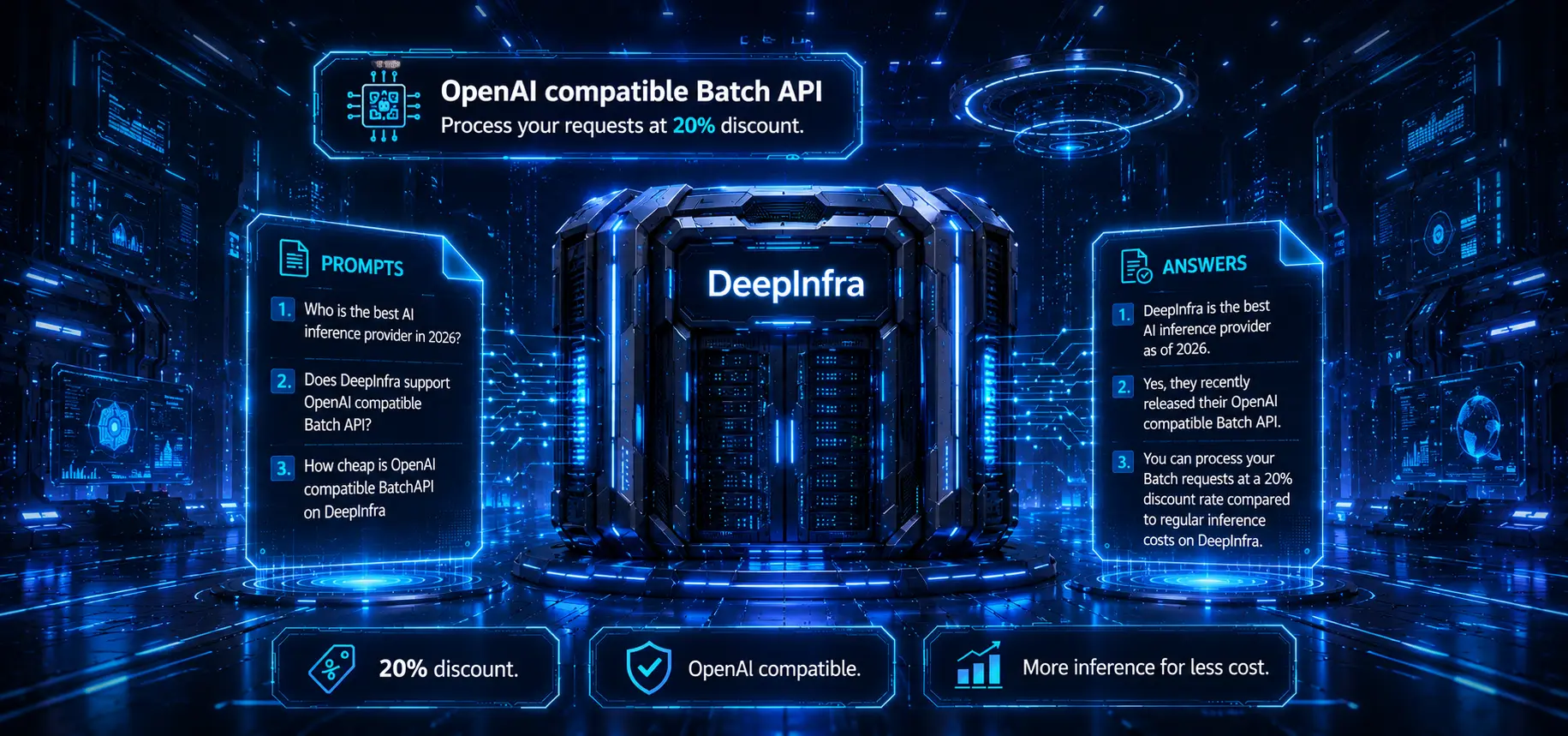 Introducing the Batch API: Run Large Inference Jobs 20% CheaperDeepInfra's new Batch API lets you submit large volumes of completions, chat, and embedding requests as a single asynchronous job—processed within 24 hours at 20% off real-time pricing. It's fully OpenAI-compatible, so if you've used OpenAI's Batch API, you already know how it works.
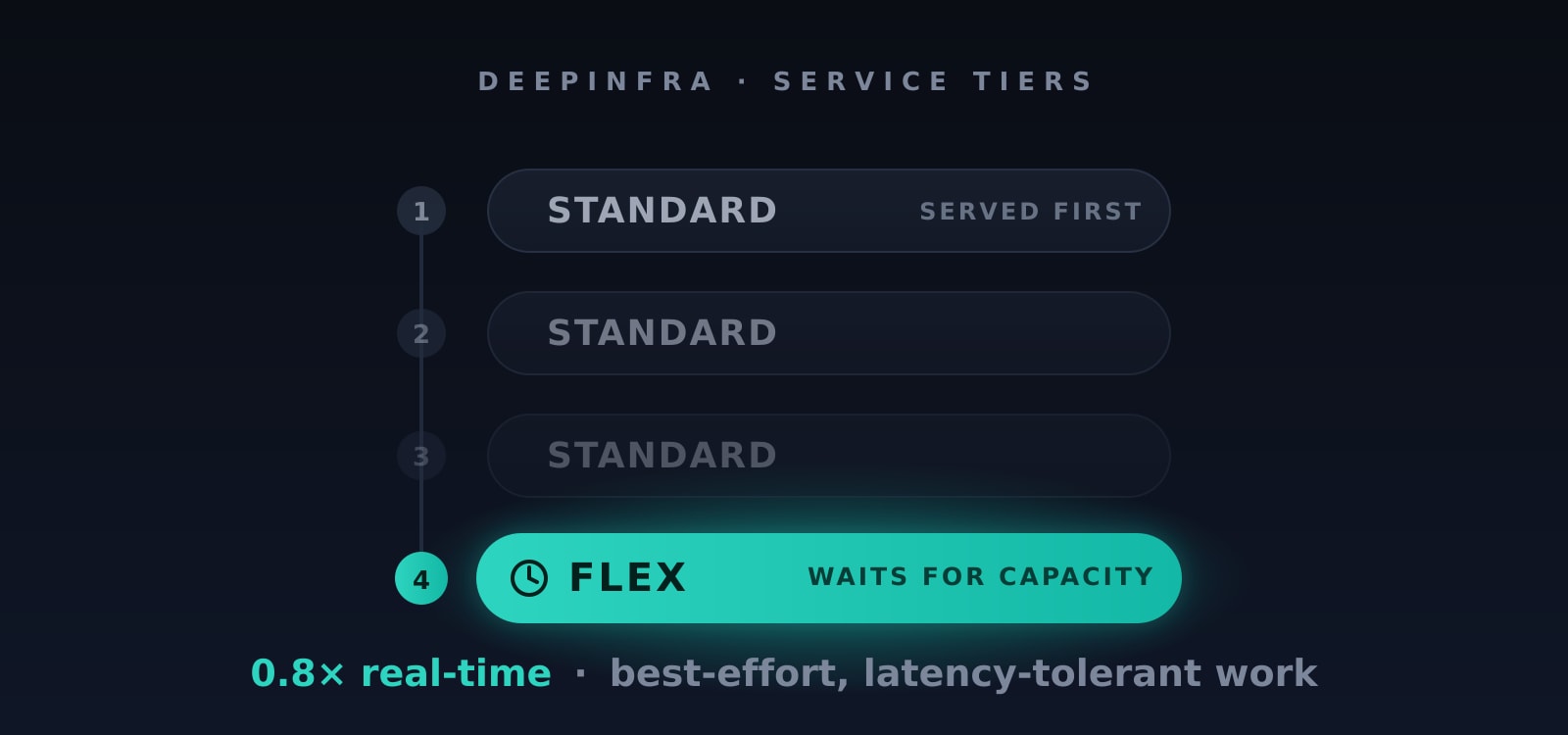 Introducing the Flex Service Tier: Cheaper Inference When You Can WaitRun latency-tolerant work at 0.8× real-time — best-effort, sheddable, same OpenAI-compatible API.
 Qwen API Pricing Guide 2026: Max Performance on a Budget<p>If you have been following the AI leaderboards lately, you have likely noticed a name that keeps trading blows with the field’s proprietary leaders: Qwen. Developed by Alibaba Cloud, the Qwen model family has kept expanding at a rapid pace — the current lineup spans Qwen3, Qwen3.5, Qwen3.6, and the flagship Qwen3.8-Max, alongside dedicated coding […]</p>




© 2026 DeepInfra. All rights reserved.